Superstition
The Best Werewolf Short Stories 1800-1849Superstition is not merely a mistaken belief about the Werewolf; it is a social force that converts rumor into identity, unexplained suffering into supernatural causation, and suspicion into punishment. Across the book, inherited stories about sorcerers, wolves, and demonic powers shape both the history of the genre and the lives of people accused of belonging to it. The most consequential pattern is the passage from folklore to action: a name is attached to a person or family, the name circulates through a community, and institutions then treat the resulting fear as evidence.
Origins and Literary Transmission
The book places werewolf superstition within a long movement from belief to folklore, from folklore to legend, and finally into literature. At the beginning of the nineteenth century, related legends existed in Greek, English, Italian, German, and French traditions, although the names and explanations varied. The usual causes were the Devil or sorcerers, and the imagined transformation therefore joined bodily change to moral guilt and supernatural agency.
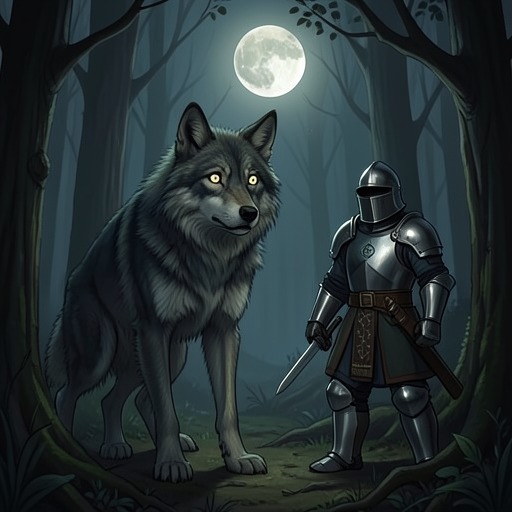
One inherited account describes werewolves as sorcerers who anoint themselves with a devil-inspired ointment and put on an enchanted girdle. While wearing it, they appear to others, and believe themselves, to possess both the form and nature of wolves; they then behave as wolves by worrying, killing, and wasting human beings. This account gives superstition a practical rule of transformation rather than treating the creature as an ordinary animal. The boundary between human weakness and animal violence is made dependent on an object, a ritual, and an alleged pact with evil.
German and French traditions attach further social consequences to the belief. In 1589, a man in the Netherlands was executed on the charge of being a werewolf, while in France the supposed sorcerer was called a Loup-garou. The belief that a wolf which has tasted human flesh will prefer it to all other food helped explain why hungry wolves were imagined as demonic agents. Their attacks on livestock, children, and newly buried bodies could thus be interpreted not as animal behavior but as the work of a more fearful power.
The tradition also entered poetry before reaching the nineteenth-century short story. The described transformation of clothing into wolf hair, arms into legs, and speech into helpless silence is identified as the first such metamorphic pattern in recorded poetry. Later medieval works continued the legend, including “William and the Werwolf” and Marie’s “Lai du Bisclavaret.” By the nineteenth century, werewolves were moving from poems and inherited tales into shorter prose narratives, a transition that made superstition available not only as belief but as a sustained literary problem.
Naming, Stigma, and Social Exclusion
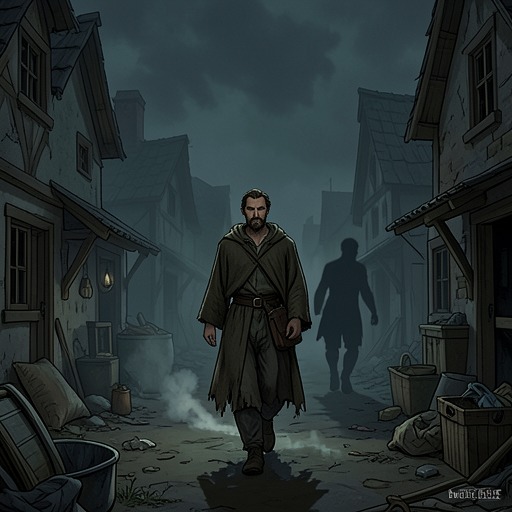
Superstition becomes most visible in the story of Hugues Wulfric and his family. Living in the Weald of Kent between Ashford and Canterbury, the Norman family survives in an isolated woodland dwelling while Anglo-Saxon neighbors regard them as an accursed race of wer-wolves. The accusation is presented as hereditary: the supposed lycanthropic stain is believed to pass from father to son through several generations. Their name therefore functions as a visible stigma before any act has been proved.
The community attributes nearly every disaster to the Wulfrics. Fires, collapsing barns, storms that flatten wheat, diseased grain, dying cattle, illness, and premature childbirth all become occasions for pointing at the family. Stories of witchcraft, theft, murder, and sacrilege circulate around hearths, in the fields, and among Sunday gatherings at the churchyard. The repetition of the stories gives them the authority of common knowledge, even though the alleged crimes shift between father, mother, daughter, and even the family’s unweaned child.
Local places intensify the accusation. The churchyard of Ashford and the carved stone cross between Canterbury and Ashford are said to be nocturnal haunts where the Wulfrics fatten on the freshly buried dead or drain the blood of passers-by. Actual events offer the raw material for the legend: wolves enter the cemetery during severe winters and disinter corpses, while a drunken beggar dies after falling against the pointed base of the cross. Superstition absorbs both incidents and assigns them to the family in its supposed wolf form, turning coincidence into confirmation.
The Wulfrics do not meaningfully control the story told about them. Aware that they are victims of calumny but unable to contradict it, they withdraw from the roads, the town, the market, the shrine, communal celebrations, and the church. The priest excludes them from communion, and the tavern-goers exclude them from the hostelry. Their avoidance is therefore both a response to persecution and an appearance of secrecy, allowing the community to read their self-protection as further proof of guilt.
This stigma produces material deprivation. After the deaths of his parents and two younger sisters, Hugues Wulfric cannot obtain work threshing grain, cutting wood, or driving the plough because farmers fear the fatality attached to the Wulfric name. He receives brutal refusals, taunts, threats, and even attacks by dogs; he is denied the alms normally given to professional beggars. Superstition thus changes from a story about an imagined creature into a system that governs employment, movement, religion, and survival.
Rumor, Authority, and Witchcraft Prosecution
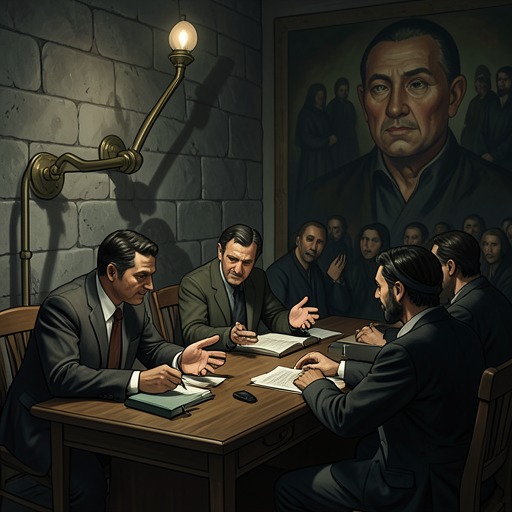
The same mechanism reappears in the persecution of Michael Thilouze and Francoise Thilouze. Victor de Vardes’s attraction to Francoise threatens an arranged alliance between the houses of De Vardes and Montmorenci. Manon Thierry, inflamed by jealousy, suggests that Michael and Francoise have bewitched Victor, although she does not actually believe the accusation. Her insinuation is enough to influence Pierre Bloui, whose own superstition carries the allegation to the foresters.
The rumor gains force because it travels through a hierarchy of power. Jacques Renard reports the foresters’ suspicions to the families of De Vardes and Montmorenci, and the aristocratic elders treat Victor’s love for a poor physician’s daughter as so inexplicable that witchcraft seems plausible. The marquis orders observation and the collection of proof. Once it becomes known that the powerful families wish Michael and Francoise ill, people suddenly discover evidence of their delinquency. The direction of belief is reversed: authority does not merely accept popular superstition but organizes and amplifies it.
Pierre then believes he has obtained physical proof. A trapped figure escapes at the cost of a left hand, leaving behind a wolf’s foot; because Francoise has in fact lost her left hand, the two circumstances are joined as supposedly incontrovertible evidence that she changed herself into a wolf. The object’s ambiguity disappears within the logic of superstition. A severed or missing hand is no longer a bodily fact requiring explanation; it becomes the visible remainder of enchantment.
Within hours, the commissaire du quartier and a mob from Loques carry Michael and Francoise away from Cabanis on charges of witchcraft. The judicial process is described as a trial only by courtesy: the powerful accusers possess every advantage, while the frightened physician and his daughter have neither protection nor effective means of defense. The wolf’s foot and Francoise’s missing hand secure their conviction, and both are condemned to die at the stake. Victor de Vardes is absent in Paris, having been sent there by his father to remove him from the scene, so the accusation proceeds without the testimony of the person whose love helped provoke it.
Belief, Resistance, and Narrative Ambiguity
The book does not present every believer as equally convinced. Branda rejects Willieblud’s account of Hugues Wulfric as a werewolf, insisting that Hugues is worth more than his reputation and suggesting that her uncle has dreamed or misunderstood the alleged sorceries. Her response establishes an alternative mode of judgment based on personal knowledge rather than inherited rumor. It also shows that superstition can be resisted, though resistance is emotionally charged because Branda’s defense is connected to her deep interest in Hugues.
Manon Thierry provides the opposite example. She does not believe that Michael and Francoise have bewitched Victor, yet she performs agreement so convincingly that Pierre leaves persuaded. Her conduct shows that superstition need not arise from sincere conviction. It can be used strategically as a language for jealousy, social resentment, or revenge, after which less powerful or less critical people carry it onward as fact.
The stories also preserve uncertainty around supernatural claims. “Ursel. The Water-Wolf” is excluded from the collection because the text never makes clear whether its water-wolf is a transformed human; the only clue is that land wolves howl when the creature approaches a boat. This hesitation matters because it marks the boundary between an animal, a monster, and a shapeshifted person. Superstition thrives on precisely such gaps in knowledge, but literary narration can leave those gaps open rather than filling them with a verdict.
In the account of Krantz, inherited belief operates through a family oath and a supernatural judgment. Krantz’s father, a wealthy but legally trapped serf in Transylvania, murders his wife and her seducer after discovering their affair. A hunter-spirit declares that the double murderer must pay the penalty attached to his marriage vow: two children are gone, the third will follow, and the father’s punishment is to live. The father later dies raving mad in Amsterdam, while Krantz remains convinced that he must somehow pay the penalty. Here superstition is not a village rumor imposed from outside but a transgenerational interpretation through which a survivor understands illness, exile, death, and his own future.
Historical and Thematic Significance
The book presents the period from 1800 to 1849 as the cradle of the werewolf short story. Werewolf superstition supplies the imaginative material, but short fiction reshapes that material into narratives about social judgment, concealed identity, inherited guilt, and the instability of evidence. The genre’s development therefore does not simply preserve old fears; it exposes how fears are produced, transmitted, and made consequential.
Across the examples, the supposed monster is repeatedly linked to a vulnerable social position: an isolated family of woodcutters, a poor physician and his daughter, a serf’s displaced child, or a person whose reputation has already been marked by communal suspicion. The label of werewolf or witch turns poverty, foreignness, unusual conduct, bodily difference, and unexplained events into a single moral category. Once that category is accepted, exclusion can appear prudent, and violence can appear just.
Superstition also reveals the instability of the boundary between the natural and the supernatural. Wolves really do emerge from forest lairs, cattle really do die, people really do disappear from ordinary society, and bodies really do bear injuries that demand explanation. The supernatural interpretation does not erase these facts; it rearranges them into a story of demonic agency. The resulting story may be false, uncertain, or deliberately manipulated, but its social effects remain real.
Its decisive significance lies in this contrast between belief and consequence. The book traces the werewolf from an old superstition into poetry, folklore, and short fiction, yet its strongest criticism falls not on the imagined wolf but on the human communities that need one. A superstition becomes dangerous when a name becomes a verdict, when rumor becomes evidence, and when institutions lend the authority of law to fear.